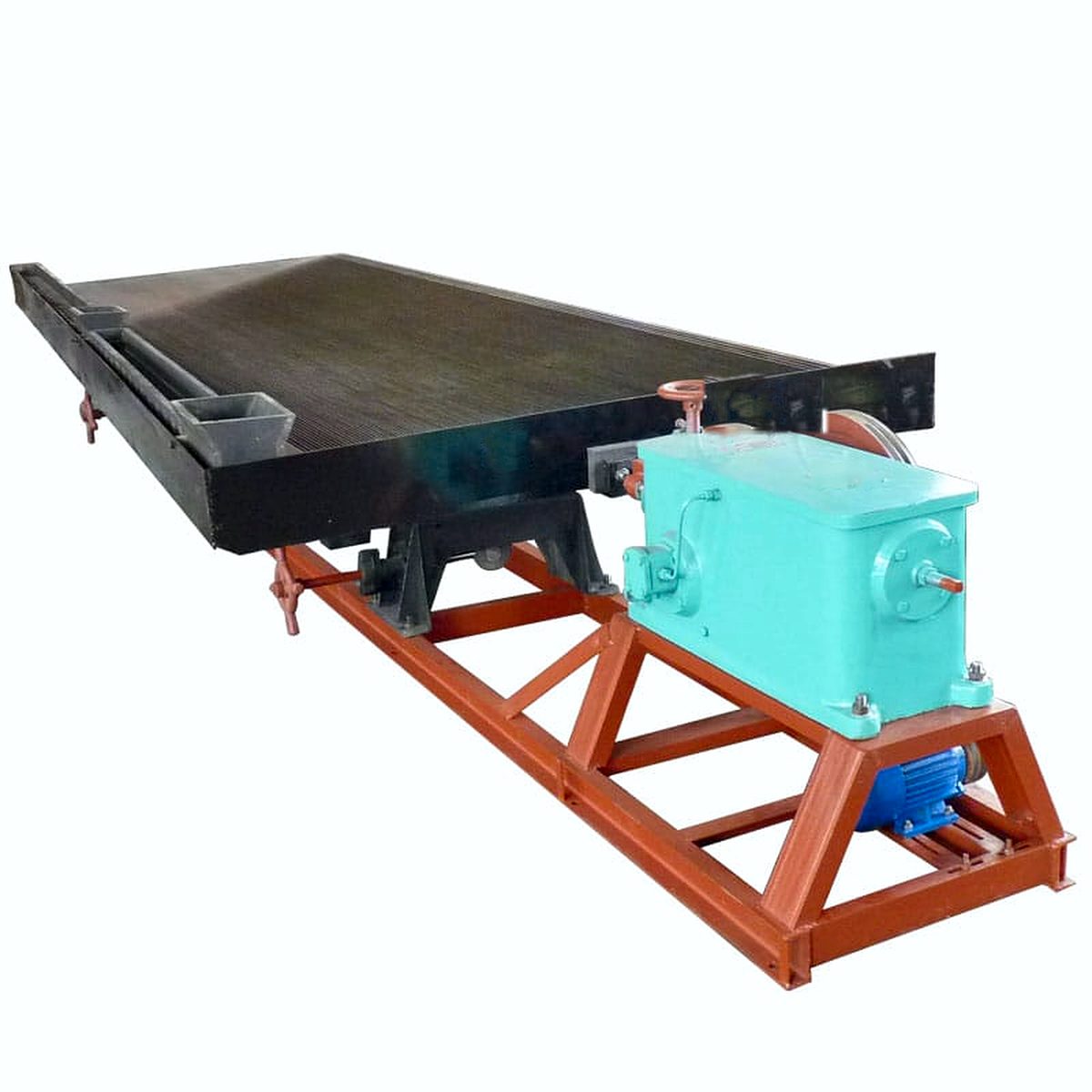
The shaking table is one of the most widely used cleaning machines in fine gravity separation, applied to tin, tungsten, gold, tantalum-niobium and many other minerals. Its great advantage is that you can see the result: minerals spread across the deck in a clear fan of bands by density, so the operator can watch and adjust directly. But a table has many settings that interact, and how well it is tuned makes a big difference to grade and recovery. Understanding the principle and then adjusting step by step is the key to getting good results.
How it works
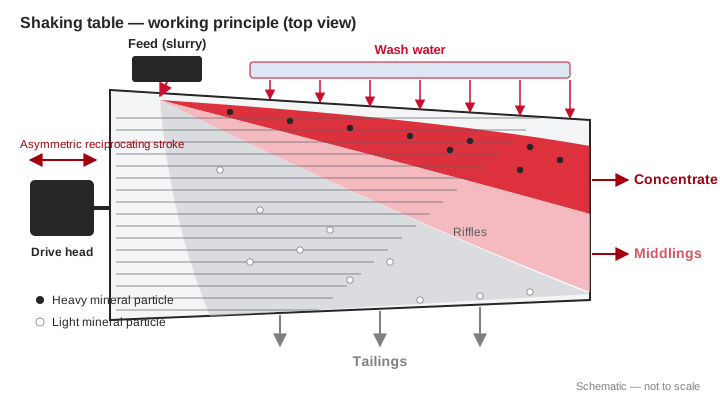
Separation on a table comes from three effects working together:
- Asymmetric (differential) motion — the head motion drives the deck back and forth lengthwise. The deck accelerates on the forward stroke and then reverses sharply at the end of it. This slow-forward, quick-return action keeps nudging the particles lying on the deck towards the concentrate end.
- Cross-flow of water — wash water runs across the slightly tilted deck from the water launder as a thin film, carrying the light particles in the upper layer towards the tailings side.
- Stratification between riffles — in the grooves between the riffles the bed is loosened by the motion and the water and sorts itself into layers: small heavy particles sink to the bottom, larger light particles ride on top. The heavy bottom layer is barely touched by the water and moves lengthwise to the concentrate end, while the light top layer is swept away sideways.
Combining the two directions of movement, particles of different density and size travel across the deck along different diagonal paths, and discharge in order from the concentrate end to the tailings side as concentrate, middlings and tailings — the characteristic fan of bands.
Main components
- Head motion — produces the differential motion; the 6-S table uses an eccentric-linkage head with adjustable stroke.
- Deck — covered with a wear-resistant surface and fitted with riffles; coarse-sand, fine-sand and slime decks differ in riffle height and layout.
- Tilting mechanism — sets the cross slope of the deck.
- Feed box and water launder — spread feed and water evenly along the upper edge of the deck.
- Frame and supports, plus product launders that collect concentrate, middlings and tailings.
Key settings and typical ranges
One general rule covers most of it: the coarser the feed, the longer the stroke, the lower the speed, the steeper the cross slope and the more wash water — and the opposite for fine feed. Feed density and feed rate must be steady; if they keep fluctuating, the bands swing back and forth and the table is almost impossible to tune.
| Setting | Coarse-sand deck (about 0.5–2 mm) | Fine-sand deck (about 0.074–0.5 mm) | Slime deck (< 0.074 mm) |
|---|---|---|---|
| Stroke (mm) | 16–22 | 11–16 | 8–16 |
| Speed (strokes/min) | about 220 | about 250 | about 280 |
| Cross slope | typically 2.5°–4.5° | typically 1.5°–3.5° | typically 1°–2° |
| Feed density (% solids) | 20–30 | 18–25 | 15–20 |
| Wash water (t/h) | 0.7–1 | 0.4–0.7 | 0.4–0.7 |
| Capacity (t/h) | 1–1.2 | 0.5–1 | 0.3–0.5 |
Stroke, speed, feed density, wash water and capacity are catalogue values for the 6-S 7.6 m² table; cross slope is a common reference range. The best values depend on the ore and are found by adjusting on site.
Single-table capacity is limited, and overfeeding is one of the most common reasons for mixed bands. When the tonnage is larger, rougher machines such as spirals or jigs normally reject most of the tailings first, and the tables only clean the rougher concentrate.
Step-by-step adjustment
- 01Install & levelSolid foundation, deck levelled lengthwise
- 02Water testSmooth running, even water film
- 03Starting settingsMid values from the table
- 04Steady feedBuild up to design rate
- 05Slope & waterPut the bands in place
- 06Stroke & speedBed moves, no bouncing
- 07Set splitters, sampleAssay, fine-tune one by one
- Install and level. The foundation must be solid and the anchor bolts tight; level the deck lengthwise as the manual specifies, or the bands will run crooked.
- Run empty, then with clean water. Check that the table runs smoothly and quietly; with water on, make sure the film covers the whole deck evenly, without dry patches or channels.
- Set starting values from the middle of the ranges above for your feed size.
- Bring the feed up gradually to the design rate and keep density and flow steady; a surge tank or distributor ahead of the tables helps.
- Adjust cross slope and wash water. Ideally the heavy-mineral band is sharp, of moderate width, and fans out from the middle of the deck towards the concentrate end.
- Fine-tune stroke and speed. Particles bouncing or tumbling on the deck mean the stroke is too long or the speed too high; sand that will not move forward and piles up means the opposite.
- Set the splitters and sample. Place the concentrate/middlings/tailings cuts to meet the grade target, sample and assay each product, and change only one setting at a time, recording the result.
Troubleshooting
| Symptom | Likely causes | What to do |
|---|---|---|
| Bands blurred and mixed | Overfeeding, feed too dense or size range too wide | Reduce feed, adjust density, classify more closely |
| Heavy minerals washed into tailings | Cross slope too steep or too much wash water | Reduce slope or water |
| Dry patches, material piling up | Too little water, slope too flat or deck not level | Add water, adjust slope, re-level |
| Concentrate grade too low | Splitter set into the middlings, too little water | Move the splitter, add a little water |
| Particles bouncing on the deck | Stroke too long or speed too high | Shorten stroke or lower speed |
| Concentrate moves slowly, builds up | Stroke too short | Lengthen the stroke a little |
| Head motion noisy or hot | Poor lubrication, loose connections or a damaged spring | Check oil, tighten, replace worn parts |
| Deck wobbles or drifts | Worn supports, loose anchors | Repair supports, tighten anchor bolts |
Routine maintenance
Check the head-motion oil level and temperature regularly; clean scale and debris from the feed box, water launder and deck; and inspect the riffles and deck surface for wear, repairing or replacing them as needed. When shutting down, stop the feed first and then rinse the deck with clean water, so sand does not settle and overload the table at the next start-up.
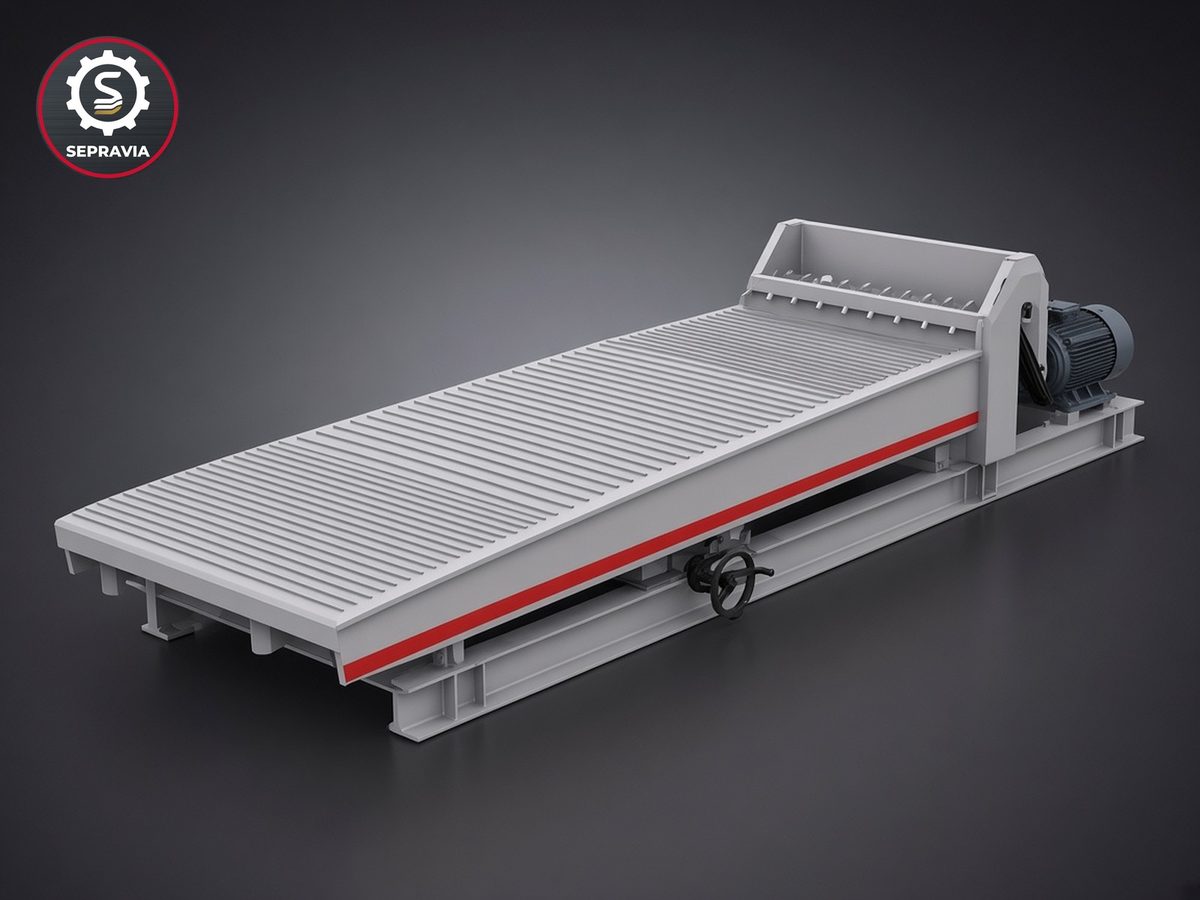 6-S Shaking TableView equipment →
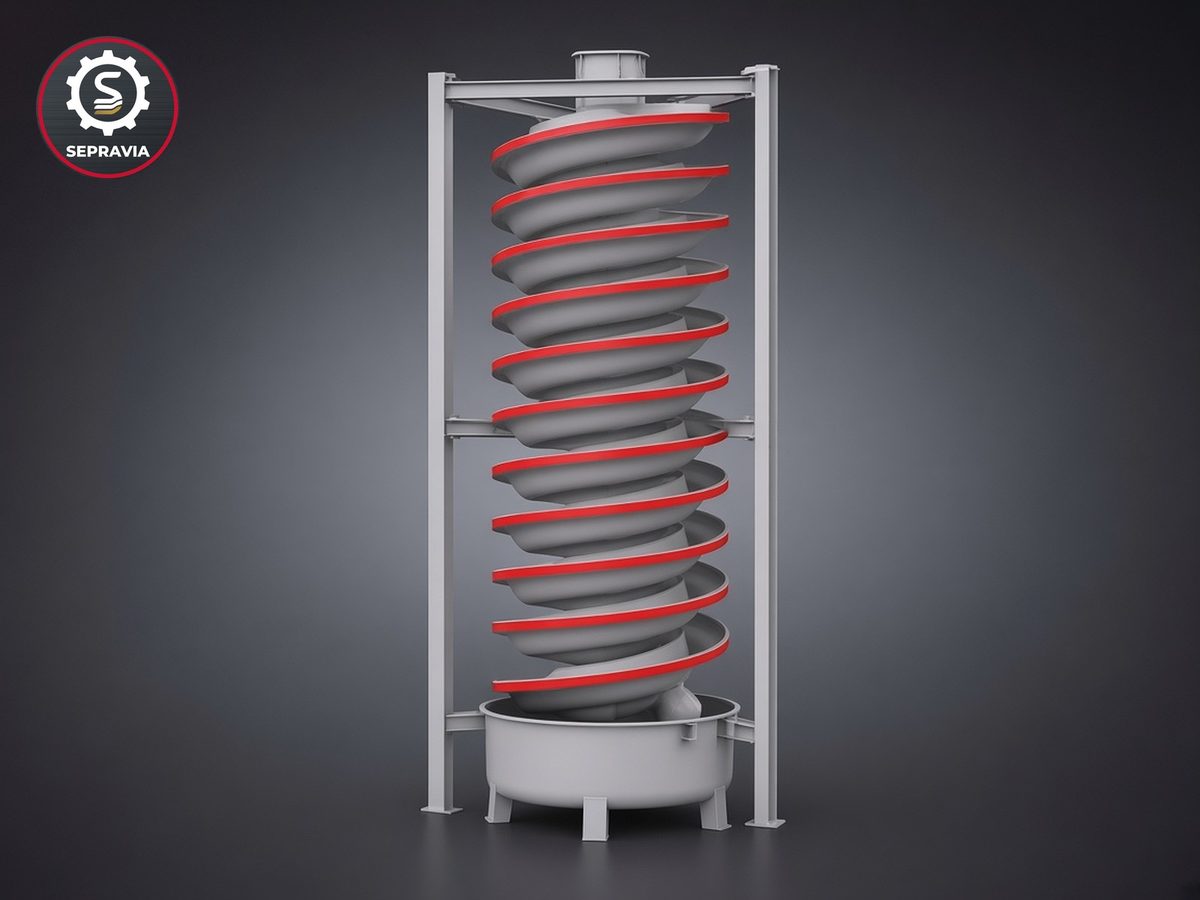 FRP Spiral ChuteView equipment →
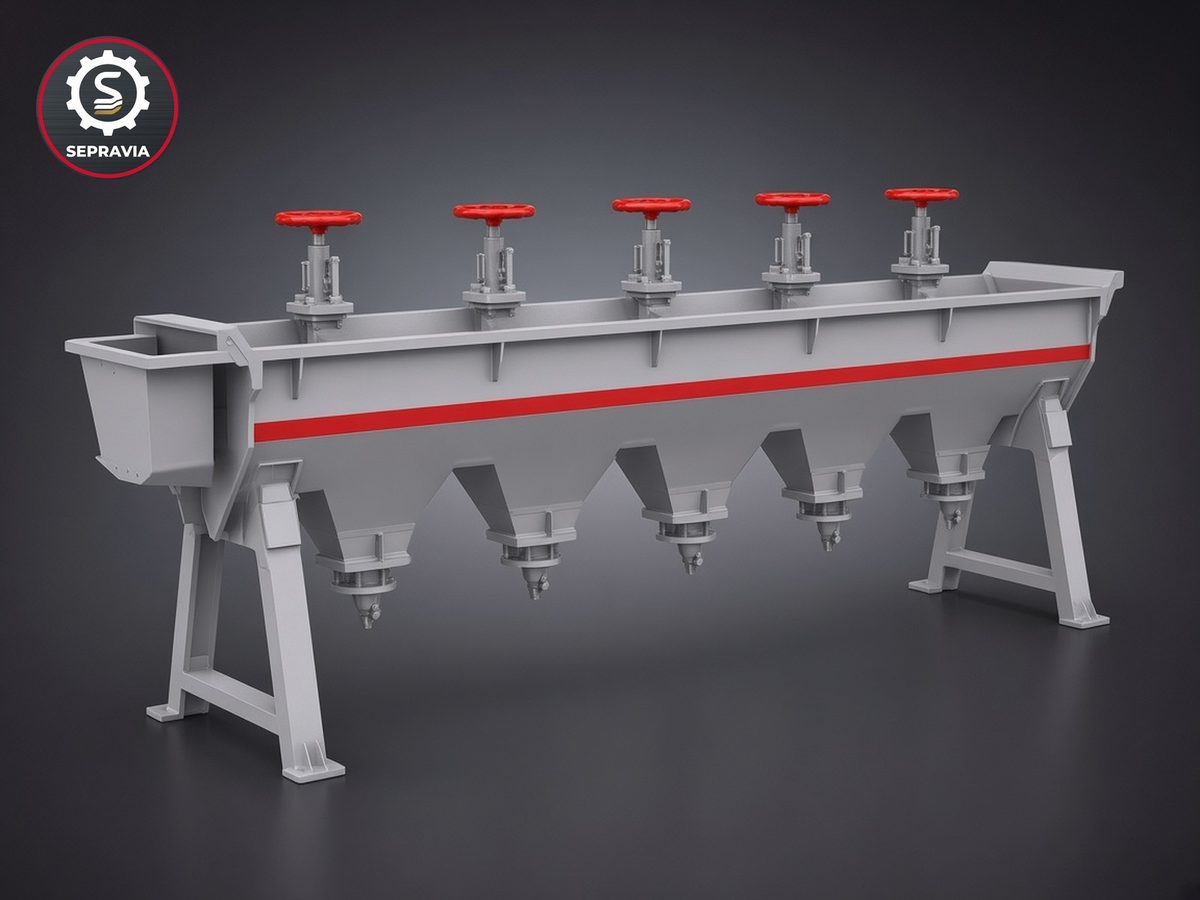 Hydraulic ClassifierView equipment →
FAQ
How much can one table handle?
It depends on deck size and feed size. For the 6-S 7.6 m² table, catalogue figures are about 1–1.2 t/h on a coarse-sand deck and about 0.3–0.5 t/h on a slime deck. For larger tonnages, rough first and use tables for cleaning.
Can coarse, fine and slime decks be swapped?
Not recommended. The riffle height and layout of each deck are designed for a particular size range, and the wrong deck noticeably worsens separation. Choose decks to match the classified size fractions.
Need a flowsheet and equipment advice for your ore?
Tell us the ore type, feed size, planned capacity and site conditions, and our engineers will recommend a flowsheet and equipment and send a quotation.
Comments
Questions or experience to share? Comments appear after review.
No comments yet — be the first.
Sign in to comment
Used only to verify you; your email is never shown.